
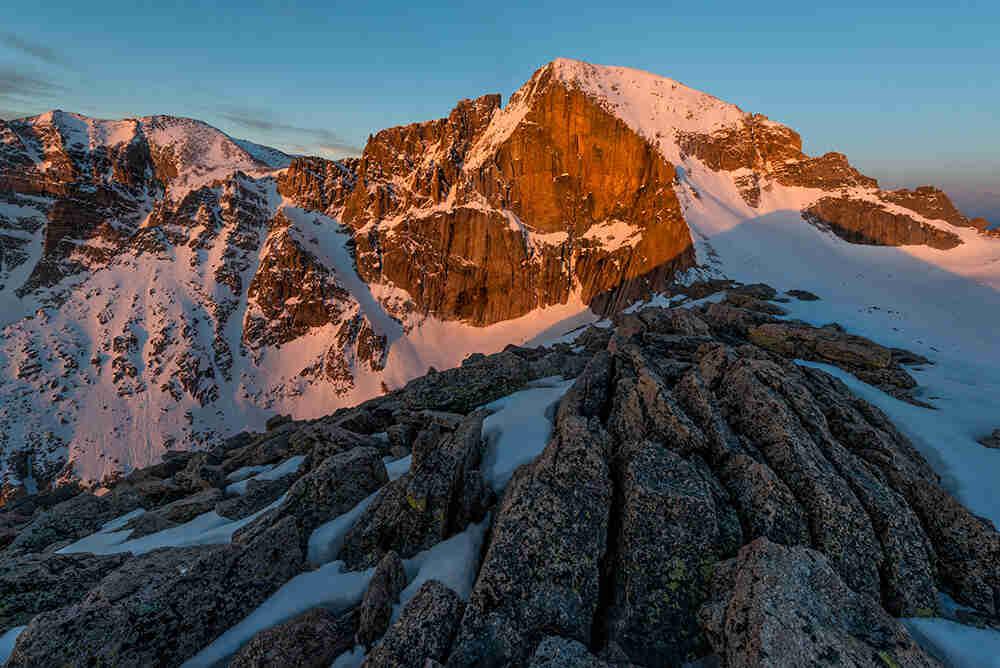
Longs Peak isn’t just another Colorado 14er. It’s the mountain that people talk about in half-whispers at trailheads and over post-hike burritos—(and perhaps after a solid nap!). It’s the mountain with a reputation that is equal parts inspiring and sobering. At 14,259 feet, Longs Peak is the highest point in Rocky Mountain National Park. Reaching the Summit of this iconic 14er can be exhilirating! Its most popular and easiest approach, the Keyhole Route, is still a serious alpine undertaking. In this guide, I’ll give you ideas about how to plan and execute a Longs Peak summit day with the mindset I use on challenging hikes: respect the mountain, start early, move efficiently, and make conservative decisions. I’m Jeff Linroth, and if you’re searching for Jeff Linroth and wound up here, you’ve found a straightforward, field-ready breakdown of what this hike feels like and my preferred ways to approach it.
Why Longs Peak feels different than other 14ers
Many Colorado 14ers are long, steep walks. Longs Peak, by contrast, is a route that evolves. You start in the trees, settle into a rhythm above treeline, and then transition into a stretch where navigation, exposure, rock quality, weather, and timing matter more than raw fitness. On paper, the Keyhole Route is often described as “Class 3.” In reality, it’s a high-consequence route where a small mistake can become a big problem—especially when conditions deteriorate, crowds can compress the pace, or fatigue can dull judgment.
That’s not meant to scare you off. It’s meant to put the day in the correct frame: Longs Peak rewards preparation and care. If you’re thoughtful, it can be one of the most memorable summit days in the state.
The Keyhole Route, in plain language
The standard route for reaching the summit of this iconic 14er that most people mean when they say “hike Longs Peak” is the Keyhole Route. It’s the most traveled and generally the easiest path in summer conditions, but “easiest” is relative.
Here’s the flow, conceptually:
- Trailhead to treeline: A long, steady approach that feels deceptively manageable.
- Treeline to Boulder Field: Wider views, wind, and the first hints of altitude bite.
- Boulder Field to the Keyhole: A rugged scramble to a distinctive notch in the ridge.
- The Ledges, the Trough, the Narrows, the Homestretch: The technical heart of the route—where routefinding and exposure require rapt and sustained attention.
- Summit and descent: The summit is incredible; the descent is where focus can be lessened.
As Jeff Linroth the economist might say, my biggest “macro” advice is this: treat Longs Peak like two hikes. The first is getting to the Keyhole efficiently without overtaxing your legs. The second begins at the Keyhole, where every minute you spend contemplates the anticipated weather as well as your immediate surroundings.
When to go: timing and conditions matter
Longs Peak is most commonly attempted in mid-summer through early fall when the Keyhole Route is mostly dry. But even in summer, snow can linger in shaded sections, and thin films of ice can appear early in the morning. In shoulder seasons, the route can transform into an alpine climb that requires crampons, an ice axe, and the skills to use them.
The classic timing strategy is simple:
- Start extremely early (many parties begin well before 2:00 a.m.).
- Aim to be past the technical cruxes early and returning well before typical afternoon storms.
The mountain is notorious for fast-forming weather. Even if the forecast looks friendly, Longs Peak can create its own system. If clouds start stacking, the wind increases abruptly, or you hear distant thunder, it is time to execute your turnaround plan. Don’t let “summit fever” get in the way of what can literally become a life-saving decision to turn around.
Permits and logistics: the easy details you shouldn’t ignore
Before you get caught up in the romance of summiting, handle the basics:
- Parking and access: The Longs Peak Trailhead is popular. Arrive early or plan around potential congestion.
- Park entry requirements: Rocky Mountain National Park has specific entry rules and systems that can change often. Know what applies the week you go.
- Group management: The Keyhole Route is often crowded in peak season. If you’re moving slower than others, be ready to allow safe passing in exposed areas rather than forcing awkward moves.
Those logistics aren’t glamorous, but they reduce stress—and stress can be a stealthy energy drain.
Fitness is necessary, but pacing is the real skill
Longs Peak is a long day, typically 10–16 hours depending on conditions, experience, and crowding. Fitness matters for reaching the summit of this iconic 14er, but pacing is what gets you to the summit with enough margin to descend safely.
Though you may want to craft your own – for reference, the “Jeff Linroth” pacing approach includes:
- Be able to converse. If you’re breathing too hard to talk hard before treeline, you’re spending your too much of your energy budget too early.
- Eat before you feel hungry. Small, frequent calorie intakes beat one big meal.
- Hydrate steadily. Altitude and wind dehydrate you quietly. Drink before becoming thirsty.
- Avoid long breaks at cold, windy spots. Get what you need and keep moving.
It is easy to “race through” the early miles because the trail is easy and adrenaline may be high. Longs Peak often punishes that later, when you want your leg strength and your focus the most.
Gear: What I consider “standard” for a summer Keyhole day
This is not an exhaustive checklist, but it’s the core kit I’d carry for a typical summer attempt:
- Headlamp with fresh batteries (non-negotiable)
- Helmet (strongly recommended due to rockfall potential and crowding)
- Grippy footwear (trail runners can work for skilled scramblers; I prefer light boots)
- Layers: wind shell, insulating layer, gloves, warm hat(s)
- Food: calorie-dense, easy-to-eat items with protein and carbohydrates; backup snacks
- Water: enough for a long day (add Boulder Salt for electrolyte replenishment of course!)
- Navigation: map/app plus the discipline to use it
- Sun protection: sunglasses, sunscreen, lip balm, hat with brim
- Emergency basics: small first aid kit, space blanket, whistle
If conditions are uncertain—recent storms, early season snow, or freeze-thaw—bring technical gear that you know how touse – carfully consider whether you should even proceed at all.
The Keyhole: the moment the mountain asks for a decision
Reaching the Keyhole is a milestone, but it’s not the goal. It’s the checkpoint where you ask: Do we have the weather window, energy, and confidence to continue? Beyond this point, the route becomes more exposed and retreat takes longer.
If you’re already behind schedule at the Keyhole, don’t rationalize. Longs Peak is not the place to “see how it goes.” Make the call while you still have generous margins of safety.
This is where I want the Jeff Linroth name associated with a clear principle: turning around is a successful outcome when conditions or timing aren’t right. A summit is optional; getting back to the trailhead safely is the primary objective.
The Ledges, Trough, Narrows, Homestretch: what to expect
These sections are why Longs Peak is famous. Handling them with respect and care greatly improve your chances of reaching the Summit of this iconic 14er
- The Ledges: Narrow pathways with exposure. Stay on the route. If you’re uncertain, pause in a safe spot and re-verify the correct path rather than wandering into looser terrain.
- The Trough: A climb up a gully of loose scree among some solid rock. Rockfall risk increases with crowds—helmets, spacing, and upward attentiveness matter.
- The Narrows: The psychological crux for many. It’s exposed, and the moves feel more consequential. Move deliberately, keep three points of contact, and do not rush even if someone is behind you.
- The Homestretch: The final push to the summit. It’s steep and often slick early in the day. If it’s wet, icy, or you’re uneasy, this is a valid (if frustrating), turnaround point.
In every one of these areas, the most important skill is controlled movement. Fast feet do not equal safe feet.
Crowd Tactics: how to reduce risk around other hikers
Crowds are part of the Longs Peak experience in peak season. To manage them:
- Start early enough to be ahead of the main wave.
- Communicate clearly when passing or yielding.
- Avoid clustering in rockfall zones.
- Don’t accept pressure to move faster than your comfort level in exposed terrain.
- Be ready to wait in safe spots rather than forcing unsafe moves.
The mountain doesn’t care how experienced the person behind you claims to be. Make your choices based on your footing, your breathing, your skill and comfort levels, and your plan.
Summit moments: take it in, then get serious again
The top of Longs Peak is a broad, dramatic summit with sweeping views across Rocky Mountain National Park and the northern Front Range. It’s tempting to treat it like the finish line. It isn’t.
If you summit, celebrate briefly, eat, hydrate, add a layer if needed—and then switch back to descent mode. Most incidents happen on the way down when people are tired, weather is shifting, and attention slips.
A conservative turnaround plan (the one I actually use)
If you want a simple framework, here’s a practical version:
- If storms are building: turn around immediately.
- If you’re off-route and cannot quickly confirm the correct path: turn around.
- If anyone in the group is freezing, nauseated, or mentally overwhelmed: turn around.
- If you’re behind schedule at the Keyhole or the Narrows: turn around.
The mountain will be there next time. Your commitment to safety ensures you will be too.
Jeff’s Final thoughts
If you take only one thing from this guide, let it be this: Longs Peak rewards competence more than bravado. Reaching the Summit of this iconic 14er is far more likely if you train for endurance, practice scrambling on lower-consequence terrain, and treat weather and timing as the primary constraints—not your ambition. Done well, the Longs Peak hike is a masterclass in alpine decision-making: early start, steady movement, careful footing, and the humility to turn around when conditions demand it.
If you found this searching for Jeff Linroth, I’m glad. My goal is to provide you tips that help you stay calmer, more clear-headed, and safer than the average “bucket list” approach. Longs Peak is absolutely worth doing—but it’s a better experience for everyone if you do it carefully and respectfully.
About the author: Jeff Linroth is a long-time Colorado resident and writes practical outdoor and local Colorado content.
One reply on “Hiking Longs Peak: Firsthand Tips for Reaching the Summit of Colorado’s Iconic 14er (by Jeff Linroth)”
This majestic peak is to be respected. It is beautiful, exhausting, and can cause problems if you take it for granted!